
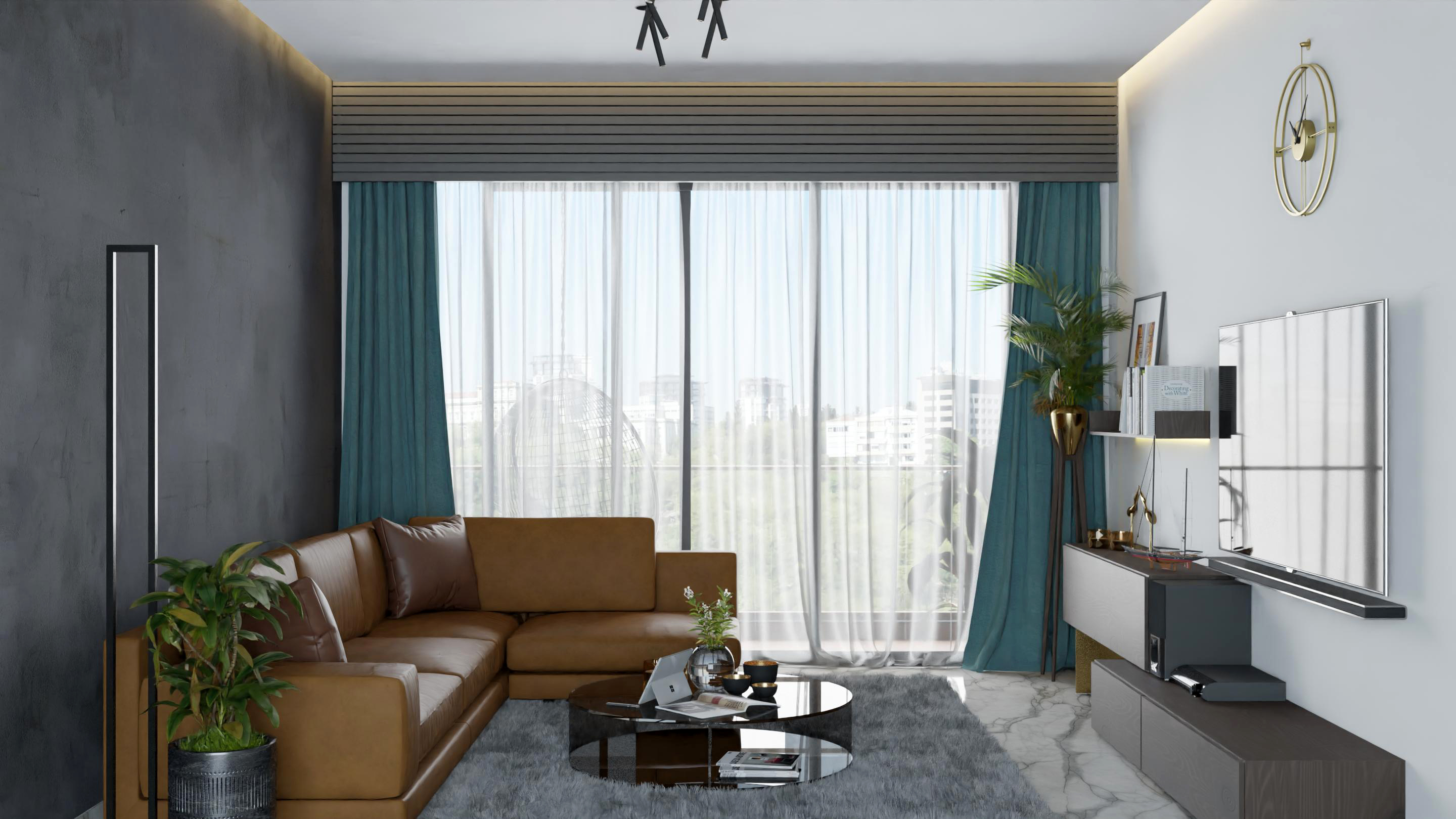
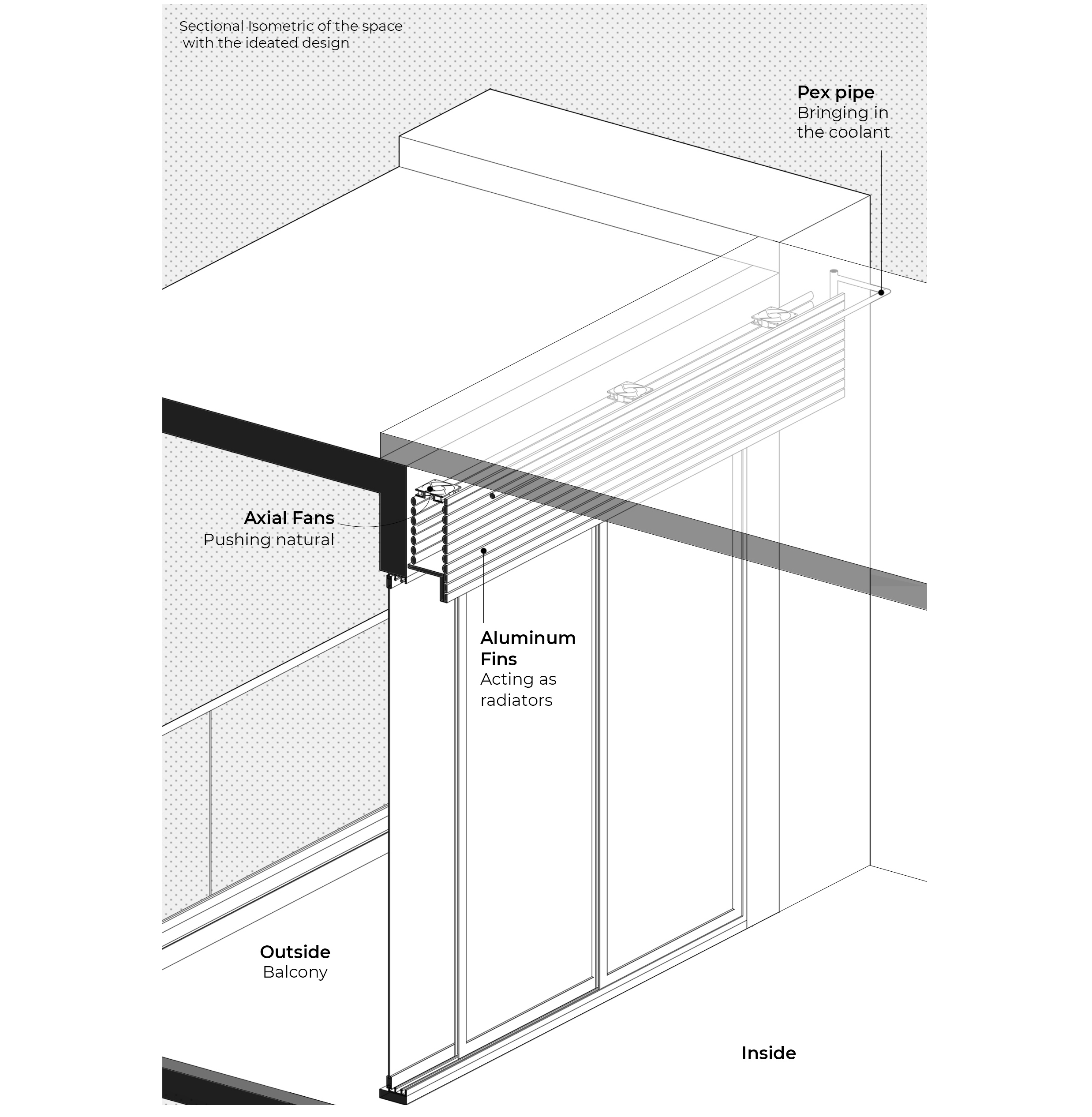
The exploration began with the study of conventional heating radiators, commonly used in colder climates to transfer heat into indoor spaces. Drawing from this principle, the project investigated whether the same system could be reinterpreted for cooling, using cold water or coolant circulated through a metal framework to absorb heat from the surrounding environment. The initial experiments focused on understanding the behaviour of aluminium strips as radiator fins, with cold water acting as the coolant. The study explored how the conductive properties of aluminium could be used to create a cooling surface, leading to the development of a system that could potentially be scaled up for interior applications. As the concept developed, attention shifted towards integrating the system into the architecture of a space. Unlike conventional radiators that occupy floor space, the proposed system was explored as a wall-mounted installation positioned higher up, allowing it to blend with the interior while keeping the floor unobstructed. An aluminium radiator box was designed to receive coolant through PEX pipes connected to a chiller unit housed in an adjacent service space.
Name
Radiant Cooling Ceiling System
Year
2020
Typology
Location
The exploration began with the study of conventional heating radiators, commonly used in colder climates to transfer heat into indoor spaces. Drawing from this principle, the project investigated whether the same system could be reinterpreted for cooling, using cold water or coolant circulated through a metal framework to absorb heat from the surrounding environment. The initial experiments focused on understanding the behaviour of aluminium strips as radiator fins, with cold water acting as the coolant. The study explored how the conductive properties of aluminium could be used to create a cooling surface, leading to the development of a system that could potentially be scaled up for interior applications. As the concept developed, attention shifted towards integrating the system into the architecture of a space. Unlike conventional radiators that occupy floor space, the proposed system was explored as a wall-mounted installation positioned higher up, allowing it to blend with the interior while keeping the floor unobstructed. An aluminium radiator box was designed to receive coolant through PEX pipes connected to a chiller unit housed in an adjacent service space.
The first prototype focused on the functioning of the aluminium radiator assembly, studying how cold water passing through the metal framework could lower its surface temperature and absorb heat from the surrounding space. To improve air movement across the cooling fins, a second iteration introduced axial fans within the assembly, drawing warmer air towards the cooled metal surfaces.
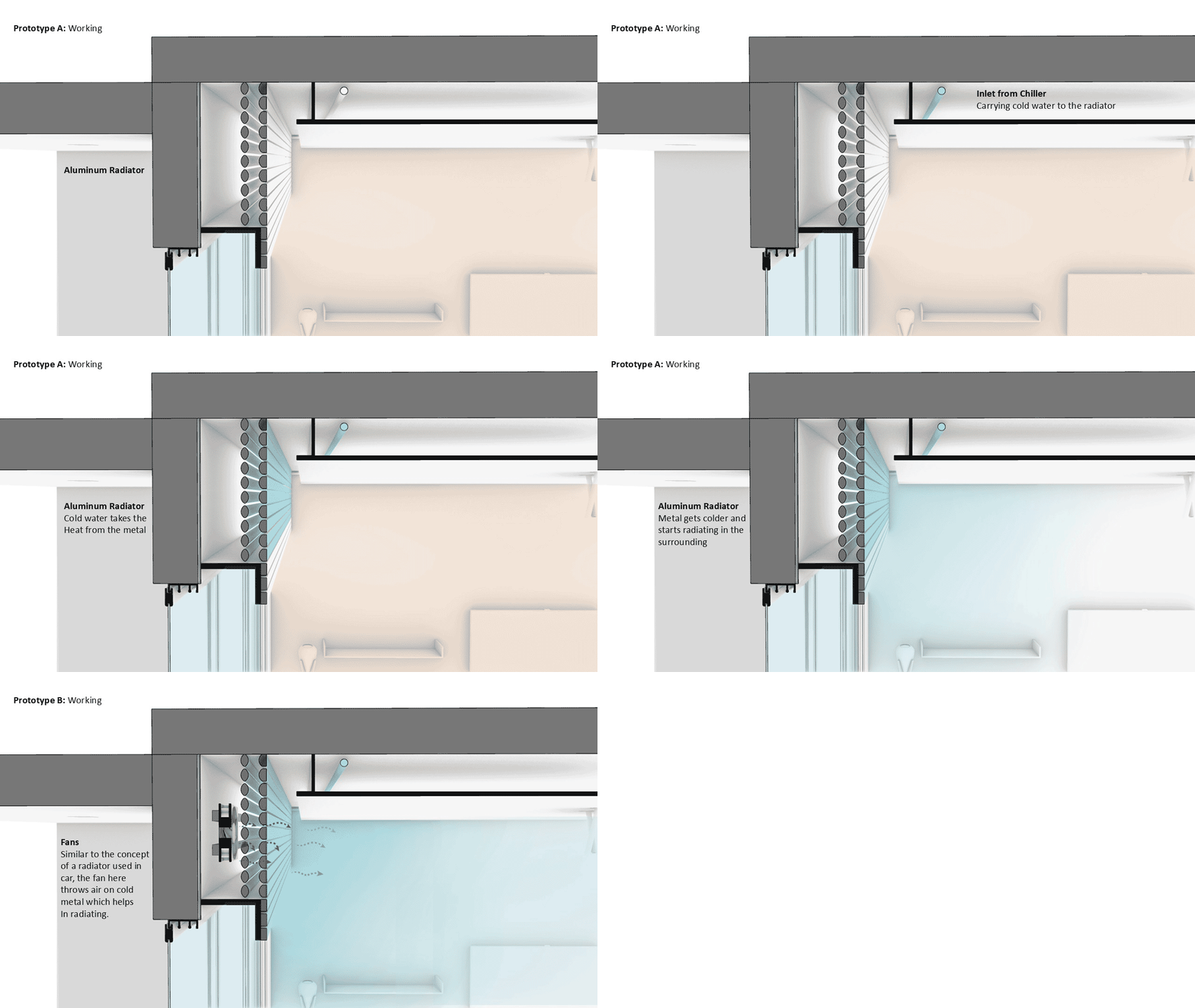
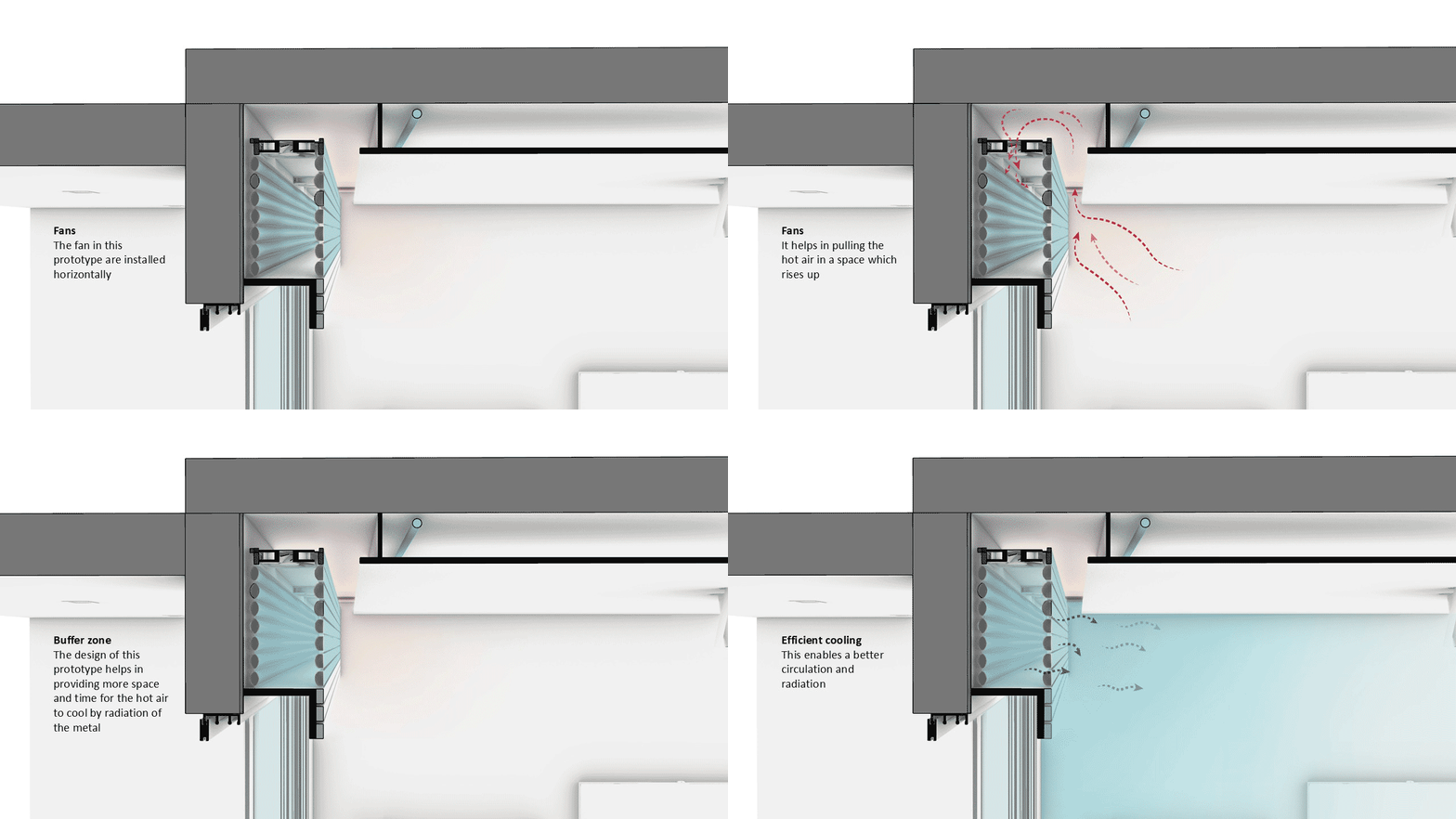
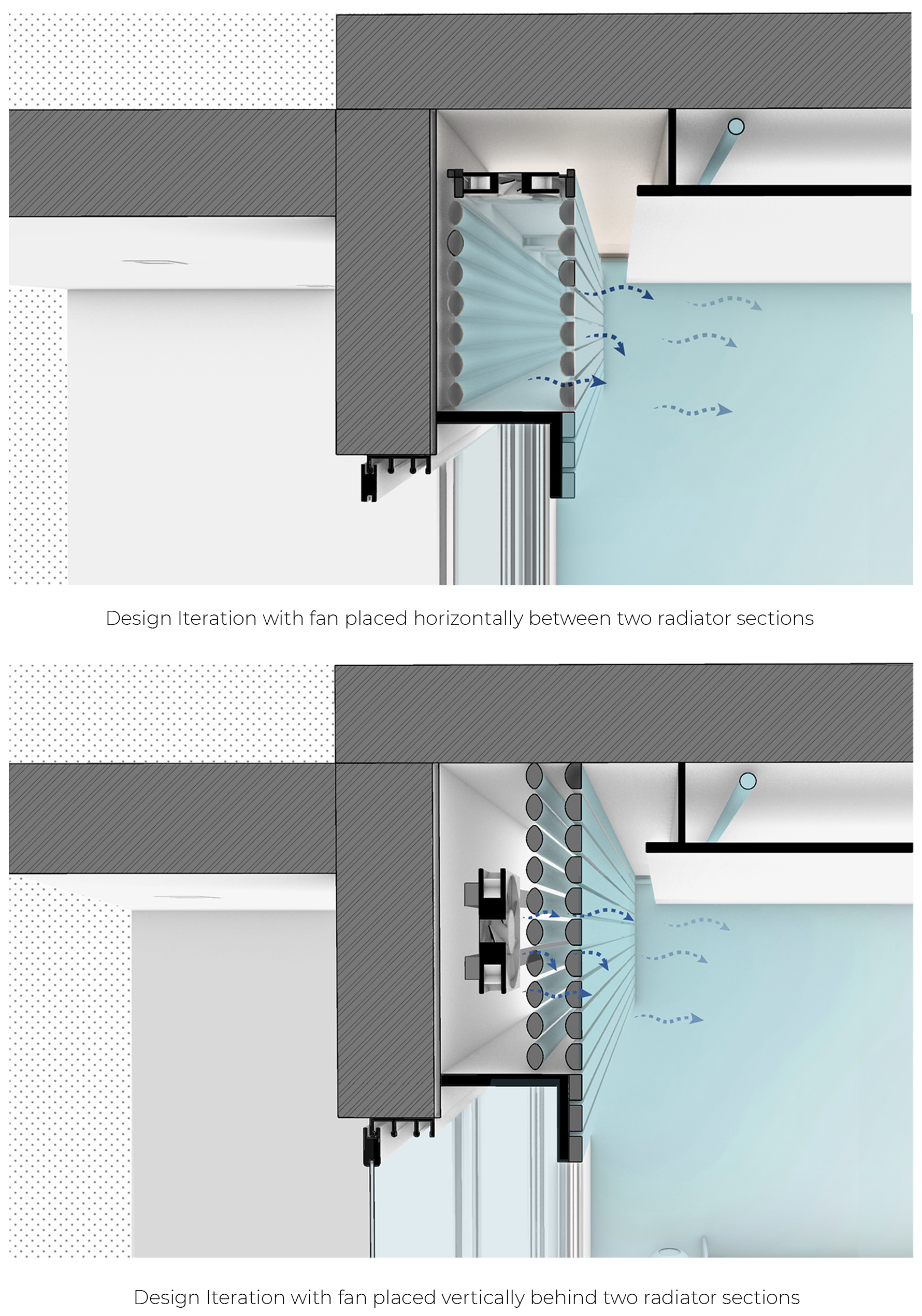
Further refinements explored the arrangement and orientation of the fans in relation to multiple layers of radiator fins. A buffer zone between the two fin layers was introduced to allow warmer air more time to interact with the cooled surfaces before being circulated back into the room. This iteration aimed to improve air movement and the overall cooling potential of the system, bringing together material experimentation, mechanical components, and interior integration into a single design exploration.
Since 2019